Most research engagements end in the same place, a report is produced, findings are presented, then almost without anyone noticing, the work moves straight into execution without the most important step having happened at all.
That step is the translation which is the process of taking what the research revealed and converting it into a recommendation that is connected to a specific commercial outcome, defensible under scrutiny and actionable in the real world.
A finding is not a recommendation however, the translation between them is the work.
This distinction matters more than most organisations realise and closing the gap between insight and action is where research-first strategy delivers its greatest value.
Step 1: The Finding
Research reveals something and sometimes it confirms what the business suspected. More often, it reveals something the brief did not anticipate which could be a customer behaviour that contradicts the assumption the strategy was built on, a pattern in the data that reframes the problem entirely, a signal that the market is moving in a direction the business has not yet accounted for.
A finding on its own carries no commercial weight – it’s information that is interesting, sometimes surprising and occasionally uncomfortable – until someone asks what this means for the decisions that come next, it remains exactly that a finding that is valuable in potential but, inert in practice.
The work begins the moment the finding is taken seriously enough to be interrogated.
Step 2: The Interrogation
Interrogation is the discipline of asking what a finding actually means for the business rather than simply what it says about the market. It is the difference between describing a pattern and understanding its implications.
The interrogation asks whether the finding reframes the problem being solved, whether it shifts where resources should be allocated, reveals a customer behaviour that the current strategy is not built around and if it challenges an assumption that has been running the business unchecked.
A finding that does not change anything is a finding that was never fully interrogated.
This step requires intellectual honesty that is sometimes difficult to maintain when the finding contradicts an existing strategic direction or challenges a decision that has already been made, it is precisely in those moments that the interrogation is most valuable.
Step 3: The Commercial Connection
An insight about customer behaviour is interesting and one about customer behaviour connected to revenue, retention, acquisition cost or market positioning is actionable.
The commercial connection is not added at the end of the process as a way of making the research feel relevant but, built into the interrogation from the beginning by asking which business decision this finding should influence and what the cost of ignoring it would be.
When the commercial connection is clear, the recommendation writes itself however, when it is absent, the recommendation becomes an opinion and opinions, however well-informed, do not survive contact with a CFO.
Step 4: The Recommendation
A recommendation built on interrogated research is not an opinion but, a finding with a direction. It states what the research showed, explains what that means for the business, connects to a specific commercial objective and proposes a strategic action that is directly traceable back to the evidence.
That traceability is what makes the recommendation defensible. It can be presented to a board, scrutinised by a CFO and measured after execution because the logic connecting the insight to the action has been made explicit at every step.
A recommendation built this way does not need to be sold. It needs only to be understood.
What This Looks Like In Practice
A client briefed us on an awareness problem their sales were declining and the instinct was that not enough people knew about the brand. The recommendation on the table before research began was a significant media spend to drive brand visibility.
The research showed something different – a greater % of lapsed customers already knew the brand as they could name it, describe it and had engaged with it before and it became clear that, awareness was not the problem but, trust was.
The interrogation asked what that meant for the business. If customers already knew the brand and still left, then spending more money to reach people who had already decided to disengage was not a strategy, it was an expensive way of confirming that the real problem had not been addressed.
The commercial connection was straightforward. Retention costs significantly less than re-acquisition. Rebuilding trust with lapsed customers who already knew the brand would deliver a better return than any awareness campaign aimed at cold audiences.
The recommendation: redirect budget from awareness to a trust rebuilding strategy, with measurement tied to retention rate and repeat purchase behaviour rather than impressions and reach.
That recommendation could not have been made without the research and the research would have been wasted without the translation.
The Work Worth Doing
The gap between a research finding and a commercial recommendation is not bridged automatically. It requires a discipline of interrogation that most engagements either rush through or skip entirely in the pressure to move towards execution.
It is in that translation from what the data shows to what the business should do because of it that research-first strategy earns its value not in the sophistication of the methodology or the volume of the data collected, but in the quality of the thinking that connects the evidence to the decision.
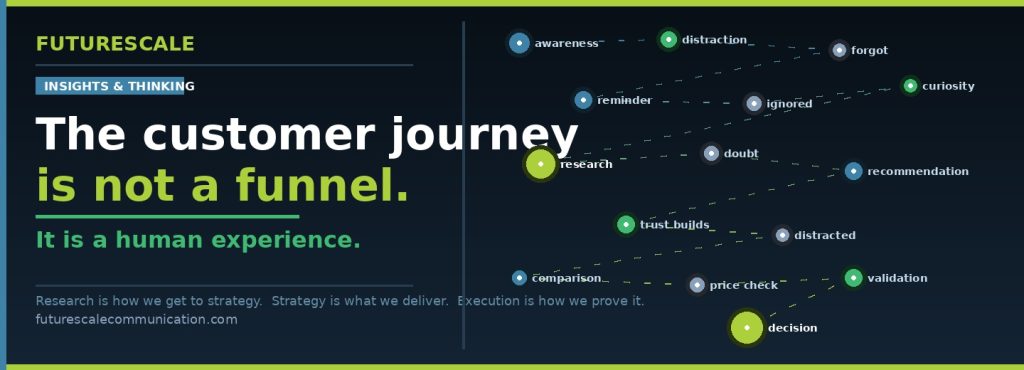
Ask most marketing teams to describe the customer journey and they will draw you a funnel. Awareness at the top, interest below that, consideration, intent and purchase at the bottom. Clean, logical, sequential. A satisfying diagram that implies control over a process that is, in reality, anything but controlled.
The funnel model captures some of the territory but leaves out the parts that matter most – parts that determine whether a customer ever arrives at a decision in your favour.
The customer journey does not follow your strategy. It follows the rhythm of a person’s life.
It begins long before you think it does
The journey does not start when a customer types a search query or clicks on an ad. It starts in a conversation with a friend. In a product someone else is using. In a problem that has not yet been named. In a moment of curiosity that has nothing to do with need.
By the time a customer actively seeks out a brand or a product, the journey is already well underway. Most of it happened invisibly and without any brand involvement at all. The awareness that matters most is often built in the spaces between formal marketing touch points, in communities, in conversations, in the quiet accumulation of impressions that eventually coalesce into a leaning towards something.
This has significant implications for where brands choose to show up and what they choose to say when they get there. A brand that only activates at the point of active search has already missed most of the journey.
It moves in every direction except straight
People become aware of something and forget about it. They get a recommendation and ignore it. They bookmark something and never return. They are almost ready to act and then something in their life interrupts them. They come back weeks later and decide in under two minutes.
The journey loops, reverses, pauses for months and then accelerates without warning. It responds to things that have nothing to do with the brand – a change in personal circumstances, conversation that reframes a priority, or a moment of readiness that arrives on its own schedule.
A strategy built on the assumption of linearity will always underperform because it is solving for a customer who does not exist. The customer who exists is moving through a far more complex and far more human process.
Emotion decides before logic arrives
Most decisions are made emotionally before logic enters the picture. People feel their way to a conclusion and then use information to justify it afterwards. This is not irrationality but, simply how human cognition works where the emotional system is faster than the rational one and it gets there first.
By the time a person is actively searching for reasons to buy something, they have often already decided. What they are doing is not evaluating. They are seeking permission to act on a conclusion they have already reached. They are not looking to be persuaded. They are looking to be reassured.
Persuasion and reassurance require completely different communication responses. Knowing which one your customer needs is the work that research makes possible.
Trust travels through other people first
Before committing to almost anything significant, people look for confirmation from someone they trust, not from the brand but another person.
A review, recommendation and or community group. Someone who has already done what they are considering doing and can report back on what happened. Trust is not built by a brand and transferred directly to a customer – it travels through other people first and arrives carrying their endorsement.
This is why word of mouth consistently outperforms advertising across every category and every market. It is not nostalgia for a simpler era of marketing but a structural reality of how human beings reduce risk before making consequential decisions. The brand that understands this designs for the social layer of the journey, not just the direct one.
Timing is readiness, not scheduling
The right message at the wrong moment is the wrong message. A person who is not ready will not respond regardless of how compelling the communication is. A person who is ready will act on very little because the decision infrastructure is already built.
Consider the South African household where the person responsible for purchasing decisions has been awake since before dawn managing the logistics of a family’s day. By the time they encounter a brand message they have already made dozens of decisions and are carrying a cognitive and emotional load that most communication strategies never account for.
Timing in the customer journey is not about the optimal hour to send a push notification. It is about understanding where in their life a person is when they encounter you and whether that moment is one they have the capacity and the inclination to act in.
What understanding the journey actually changes
When strategy is built on the actual customer journey rather than the assumed one, several things change.
The questions you ask before writing a brief change. Instead of ‘what do we want to say’ the question becomes ‘where is the customer in their journey and what do they actually need from us at this moment.’ The metrics you track change. Instead of measuring impressions and click-through rates in isolation, you begin to map signals of readiness, trust and intent. The channels you prioritise change. Instead of broadcasting to the widest possible audience, you focus on showing up with precision at the moments that matter.
Most significantly, the relationship between the brand and the customer changes. A brand that understands how people actually move towards decisions stops trying to push customers through a process and starts showing up as genuinely useful at the points in their journey where useful things are welcome.
That shift from process thinking to behaviour thinking is where strategy stops being a plan and starts being something a real person can actually use.
The work worth doing
Understanding the customer journey properly is not a creative exercise. It is a research discipline that requires interrogating assumptions, analysing real behaviour, mapping decision patterns across real contexts and building strategy around what the evidence shows rather than what the brief assumes.
The customer journey is messy, non-linear and deeply human. The brands that navigate it most effectively are the ones that accept that reality rather than trying to simplify it away.
Understand the human experience behind the decision and everything else follows.
Futurescale is a research-first marketing, strategy and data-led growth agency based in Pretoria, South Africa. We help B2B organisations understand how their customers actually make decisions and build strategy around what the evidence shows.
Research is how we get to strategy. Strategy is what we deliver. Execution is how we prove it.
Why the most valuable customers are made in the moments when everything falls apart.
The best marketing strategy in the world is worthless if it’s not designed for how decisions actually get made.
This isn’t marketing theory. This is market reality.
Every funeral director knows this truth intimately. Every emergency loan officer lives it daily. Every private healthcare provider has built their practice around it. Yet, most marketing agencies still architect strategies assuming customers will engage multiple times before deciding when urgency customers get exactly one interaction to choose you.
In South Africa’s highest stakes markets, the careful, considered customer is largely a myth.
The 11 PM call that changes everything
Picture this: A 34 year old professional in Sandton receives a call at 11 PM. Her father has collapsed. The ambulance is en-route. Her world just shifted from routine Tuesday evening to family crisis in the span of a phone call.
Over the next 72 hours, she’ll make financial decisions totaling over R200,000. Funeral arrangements. Gap cover for unexpected medical expenses. Emergency finance to bridge cash flow gaps. Each decision carries emotional weight and long term financial consequences.
But here’s what won’t happen: She won’t spend weeks researching five different funeral parlours. She won’t compare gap cover options across multiple insurers. She won’t shop around for the best emergency loan terms or negotiate interest rates.
She’ll choose whoever feels most competent when everything feels chaotic.
This is what we call the compression point, where months of traditional marketing consideration collapse into minutes of urgent selection. Most brands are completely invisible when it happens.
The invisible marketplace
Traditional market research misses these moments entirely. Customer journey mapping can’t predict when someone’s world will suddenly require immediate solutions. Brand awareness studies don’t capture who comes to mind at 2 AM when crisis hits.
Yet, these compressed decision moments represent some of the most valuable customer acquisitions in the entire economy. Urgent customers don’t just buy, they buy quickly, pay premium prices, and develop strong loyalty because switching costs feel prohibitively high when the original decision was made under intense pressure.
The agencies that understand this aren’t just building marketing campaigns. They’re engineering systematic competitive advantage from crisis moments.
Why marketing systems break under pressure
Most marketing strategies whether linear customer journeys or sophisticated omnichannel experiences assume customers will engage with multiple touch points before deciding. But, urgency economics collapse all those touch points into one critical interaction.
Here’s why traditional marketing fails in crisis moments:
Need recognition becomes solution selection. There’s no discovery phase because the problem just became unavoidable and needs immediate resolution. The moment someone realizes they need emergency finance, they’re already evaluating who can provide it fastest.
All evaluation happens instantly. Price sensitivity, feature comparisons, and brand preferences get compressed into a single moment of “who can solve this now?” The careful consideration process that most marketing nurtures simply doesn’t exist.
Authority shifts under pressure. The person researching options isn’t always the person making the final decision, and stress redistributes decision making power within families and organisations. The 34 year old handling her father’s crisis might be coordinating with siblings, spouses, and other family members in real time.
Most marketing systems can’t handle this compression. They’re designed to nurture engagement across multiple interactions, not prove competence in a single critical moment.
The psychology of compressed choice
Understanding urgency marketing requires understanding how human psychology changes under pressure. When people face crisis situations, their decision making processes fundamentally shift:
Cognitive capacity decreases. Stress and emotional pressure reduce people’s ability to process complex information, compare detailed options, or think through long term implications.
Risk tolerance changes. Paradoxically, people become both more risk averse and more willing to pay premium prices to eliminate uncertainty quickly.
Social proof becomes critical. Under pressure, people rely heavily on external validation, regulatory credentials, testimonials, and immediate evidence of competence matter more than brand personality or creative messaging.
Time becomes the ultimate constraint. Every hour of delay feels exponentially more expensive, making speed and availability premium differentiators.
These psychological shifts create opportunities for brands that understand how to provide immediate confidence and competence signals.
The invisible advantage: engineering crisis moments
The agencies that truly understand urgency economics don’t just think about being present in crisis moments, they think about systematically engineering those moments for competitive advantage.
Consider the car finance example more deeply. When someone’s finance lapses, they’re dealing with multiple layers of stress: financial embarrassment, transportation anxiety, potential impact on work and family responsibilities, and time pressure to resolve the situation quickly.
The brands that capture these customers don’t just offer replacement financing. They offer dignity restoration. They position themselves as partners who understand the situation without judgment and provide solutions that help people regain control quickly.
This contextual intelligence understanding both the functional and emotional needs created by urgency becomes a sustainable competitive advantage because it’s difficult for competitors to replicate without fundamentally restructuring their approach to customer engagement.
The trust equation under pressure
In normal circumstances, trust builds slowly through repeated exposure, social proof, and gradual familiarity. Under urgency, customers need immediate proof of competence, not gradual relationship building.
This fundamental shift changes what creates trust:
Operational transparency replaces marketing messaging. “We can have someone at your location within 2 hours” demonstrates immediate capability. “We care about your family during difficult times” is just words that require no proof.
Risk mitigation replaces benefit amplification. “No upfront fees” or “Money back if not satisfied” removes immediate barriers to trying your service. “Competitive rates” requires comparison shopping they don’t have time for.
Immediate accessibility replaces brand recall. Being discoverable at 11 PM on a Sunday matters more than being memorable from last month’s advertising campaign.
The truth about urgent trust is this: it isn’t built over time it’s proven in real time. And the proof happens in operational details that most marketing completely ignores.
The economic advantage of urgent customers
Here’s where most agencies stop thinking strategically. They focus on being ready for urgent moments rather than understanding why urgent customers create systematic competitive advantage.
Urgent customers aren’t just more valuable, they’re different customers entirely:
They buy faster. Decision cycles that normally take weeks or months compress into hours or days, accelerating revenue realisation and reducing customer acquisition costs.
They pay more. Price sensitivity drops dramatically when time pressure is high, creating opportunities for premium pricing on both primary services and add on offerings.
They stay longer. Switching costs feel higher when the original decision was made under pressure, leading to stronger customer retention and higher lifetime value.
They refer more. People who receive competent help during crisis moments become powerful advocates, generating high-quality referrals from similarly urgent situations.
This creates a compounding advantage. Brands that systematically capture urgent customers build customer bases with fundamentally different economic characteristics higher lifetime value, lower price sensitivity, stronger loyalty, and more valuable referral networks.
But this advantage only materialises if the marketing system is architected for that outcome from the beginning.
Beyond response: engineering systematic advantage
Most agencies think tactically about urgency: faster response times, 24/7 availability, mobile-first experiences. These are table stakes, not strategy.
Strategic urgency marketing means understanding that crisis moments aren’t interruptions to normal customer behaviour, they’re when the most important customer relationships get formed.
Predictive positioning. Instead of waiting for urgent needs to arise, agencies should help their clients position themselves in the channels and contexts where urgent decisions happen. This might mean partnerships with hospitals, funeral homes, or automotive service centres rather than traditional advertising channels.
Always-on credibility systems. Building regulatory compliance, operational transparency, and risk mitigation into every customer touchpoint, not just crisis-response protocols.
Contextual intelligence platforms. Creating systems that can immediately understand and respond to the specific emotional and functional context of each urgent situation, not just the surface-level service request.
Advantage amplification. Using each successfully captured urgent customer to strengthen positioning for the next crisis moment through testimonials, case studies, operational improvements, and referral systems.
The South African context
South Africa’s economic and social context creates particular advantages for brands that master urgency marketing:
Economic pressure creates frequent urgent decisions. With 38% of consumers regularly struggling to pay bills in full, urgent financial decisions are common rather than exceptional.
Cultural factors intensify time pressure. Family and community expectations around funeral arrangements, medical care, and financial responsibilities create additional urgency beyond just individual need.
Infrastructure challenges reward preparedness. Load-shedding, transport challenges, and service delivery issues make reliability and immediate availability even more valuable differentiators.
Regulatory changes create trust gaps. Ongoing changes in financial services regulation create opportunities for brands that can demonstrate immediate compliance and credibility.
Digital adoption enables rapid response. Increasing smartphone penetration and digital payment adoption create infrastructure for responding to urgent needs in real-time.
These contextual factors mean that urgency marketing advantages can be more significant and more sustainable in South African markets than in more stable economic environments.
The measurement challenge
Traditional marketing metrics miss urgency economics entirely. Brand awareness, consideration rates, and customer journey analytics assume the gradual, multi-touchpoint processes that simply don’t exist in crisis moments.
Urgency marketing requires different measurement approaches:
Crisis moment visibility. Can customers find you when they need you at unexpected times and through unexpected channels?
Competence signal effectiveness. How quickly can you prove credibility to someone who’s never heard of you before?
Single interaction conversion rates. What percentage of urgent prospects become customers after just one meaningful interaction?
Urgency customer lifetime value. How do customers acquired during crisis moments perform compared to customers acquired through traditional marketing?
Crisis to advocacy timelines. How quickly do urgent customers become referral sources, and how valuable are those referrals?
Implementation: building for urgency
Transforming marketing systems for urgency economics requires fundamental architectural changes, not just tactical adjustments:
Channel strategy revision. Moving budget from broad awareness channels to high intent, high urgency discovery points.
Technology infrastructure. Building systems that can respond instantly to urgent inquiries rather than routing them through standard sales processes.
Team training and empowerment. Enabling customer facing teams to make immediate decisions rather than requiring approvals that urgent customers can’t wait for.
Partnership networks. Creating referral and collaboration relationships with other service providers who encounter urgent customers.
The strategic imperative
The question isn’t whether your customers make urgent decisions. They do.
The question isn’t whether crisis moments create valuable customer relationships. They do.
The real question is whether your marketing system is architected to systematically capture competitive advantage from the moments when everything else falls apart.
Because those are the moments when real competitive advantage gets built.
Most agencies will continue thinking tactically about urgency being faster response times, better availability, smoother customer experience. These improvements matter, but they’re not strategic differentiation.
The agencies that matter understand something deeper: urgency economics create opportunities to build different types of customer relationships with different economic characteristics. Higher value, stronger loyalty, more referrals, less price sensitivity.
But only if you engineer your marketing system for crisis moments rather than just hoping to respond well when they happen.
The urgency economy isn’t coming. It’s here.
The only question is whether you’re building for it.
We’ve been running digital campaigns for South African businesses across finance, logistics, healthcare, and professional services for years. The pattern we kept seeing was puzzling: companies with flawless marketing materials often had lower conversion rates than those with more “imperfect” presentations.
Initially, we thought it was coincidental. Better products naturally lead to better results, regardless of marketing polish. However, when we dug deeper into the data and started analysing customer behaviour, we discovered something that challenged everything we thought we knew about building trust through marketing.
Customers’ skepticism isn’t triggered when you make mistakes. It’s triggered when you appear too perfect to be real.
This insight is reshaping how we approach marketing strategy for our clients, and the early results suggest we’re onto something significant for the South African market.
The trust paradox: why perfection breeds suspicion
The psychology behind customer skepticism
South African consumers, particularly in high stakes industries like financial services and healthcare, have developed sophisticated mental filters for detecting inauthentic marketing. This isn’t unique to South Africa, but the combination of economic uncertainty and a history of corporate scandals has made local consumers particularly wary of brands that seem “too good to be true.”
When customers encounter marketing that appears flawless, their brains activate threat detection systems rather than reward centres. This happens unconsciously, within seconds of encountering your brand messaging.
The cognitive process looks like this:
Initial exposure: Customer sees perfect testimonials, flawless reviews, impossible promises.
Pattern recognition: Brain compares this to past experiences with deceptive marketing.
Threat assessment: Subconscious decision that “this doesn’t feel real”.
Protective response: Customer becomes more cautious, asks more questions, or simply leaves.
The counterintuitive solution: strategic imperfection
Learning from global success stories
While analysing this phenomenon, we studied how successful global brands handle authenticity. The examples were revealing:
Netflix prominently displays 1star and 2star reviews of their own original programming. Instead of hurting their brand, this transparency makes their positive reviews more credible.
Amazon shows negative product reviews first in many categories, and customers have learned to trust products with mixed reviews more than those with only positive feedback.
Airbnb allows hosts to see their lowest ratings and encourages them to address concerns publicly, creating a culture of continuous improvement rather than defensive perfection.
These companies discovered that admitting flaws makes customers believe their strengths are genuine.
The ancient psychology at work
This isn’t a modern marketing trick, it’s based on ancient human psychology. When someone admits a weakness, our brains assume they’re being honest about their strengths too. This cognitive bias, known as the “weakness effect,” has been influencing human relationships for millennia.
In business contexts, this translates to increased credibility, higher trust scores, and ultimately better conversion rates.
Industry specific applications in South Africa
Financial services
The financial sector in South Africa carries particular trust challenges given historical issues and current economic pressures. Our experiments with authenticity in this sector have focused on:
Transparent fee structures: Showing exactly what clients pay and why, rather than hiding costs in fine print.
Realistic outcome expectations: Communicating probable returns rather than best case scenarios.
Advisor authenticity: Featuring real financial advisors discussing both successes and challenges in their work.
Healthcare and Medical services
Healthcare consumers are increasingly skeptical of medical marketing that seems too polished or promises unrealistic outcomes:
Treatment realities: Honest discussions about recovery times, potential complications, and success rates.
Staff authenticity: Real healthcare providers explaining procedures in plain language.
Patient journey transparency: Showing what patients actually experience, not just ideal outcomes.
Professional services
Law firms, consulting practices, and other professional services are experimenting with:
Case Study honesty: Sharing challenges encountered and how they were resolved, not just final successes.
Process transparency: Explaining exactly how services are delivered and why they take time.
Team reality: Showing the actual people who will do the work, not just senior partners.
The strategic framework: implementing authenticity without damaging your brand
The four pillars of strategic authenticity
1. Selective transparency Not everything needs to be shared, but what you do share must be genuine. Choose areas where honesty differentiates you positively from competitors.
2. Contextual imperfection Frame limitations as standards rather than failures. “We only take on projects we can complete to our standards” communicates selectivity, not inability.
3. Proactive honesty Address potential concerns before customers have to ask. This demonstrates confidence and reduces perceived risk.
4. Continuous improvement narrative Present your business as constantly evolving rather than already perfect. This allows for growth and adaptation.
Implementation guidelines
Start Small: Begin with one area of your marketing where increased transparency could differentiate you positively.
Monitor response: Track how customers react to authentic content versus traditional marketing messages.
Stay professional: Authenticity doesn’t mean unprofessional. Maintain quality standards while increasing transparency.
Be strategic: Choose what to be honest about based on what matters most to your specific customer base.
What we’re learning: ongoing insights and observations
Customer behaviour changes
We’re noticing shifts in how customers interact with authentic marketing:
Deeper engagement: People spend more time with content that feels real.
Better questions: Inquiries become more specific and informed.
Higher intent: Customers who engage with authentic content seem more ready to purchase.
Stronger relationships: Client relationships appear to start from a foundation of mutual honesty.
Competitive Dynamics
Interesting competitive effects are emerging:
Market differentiation: In sectors where everyone claims perfection, honesty stands out dramatically.
Competitor response: Some competitors are beginning to adopt similar transparency approaches.
Customer expectations: Consumers are starting to expect more honesty from all service providers.
Long term brand building
The long term effects on brand building appear positive:
Trust accumulation: Authentic brands seem to build trust faster and more durably.
Crisis resilience: Companies with authentic marketing approaches appear better positioned to handle challenges.
Word of Mouth quality: Referrals from customers who engaged with authentic marketing tend to be higher quality.
Challenges and Considerations
The risks of strategic authenticity
Competitor advantage: Revealing limitations might give competitors talking points.
Customer misunderstanding: Some customers might misinterpret honesty as incompetence.
Internal resistance: Teams might resist sharing anything that seems like weakness.
Execution complexity: Authentic marketing requires more nuanced messaging than simple claims.
Measuring success
Traditional marketing metrics don’t always capture authenticity’s impact:
Quality over quantity: Fewer but better-qualified leads might be the goal.
Long term relationships: Benefits might not appear in immediate conversion data.
Brand perception: Changes in customer trust are difficult to measure quickly.
Competitive positioning: Market differentiation effects develop over time.
The South African context: why authenticity matters here
Economic and Social factors
South African consumers face unique pressures that make authenticity particularly valuable:
Economic uncertainty: People are more careful with spending decisions and research options thoroughly.
Corporate skepticism: Historical experiences with corporate failures make consumers wary of big promises.
Community values: Ubuntu philosophy emphasises genuine relationships over transactional interactions.
Information access: High internet penetration means consumers can easily verify claims and compare options.
Cultural considerations
South African business culture has aspects that align well with authentic marketing:
Relationship focus: Business success often depends on personal relationships and trust.
Community integration: Businesses that genuinely serve their communities tend to succeed long term.
Diverse market needs: Authentic understanding of different customer segments is crucial.
Local relevance: Global marketing approaches often need authentic local adaptation.
Looking forward: the future of authentic marketing
Emerging trends we’re watching
AI and authenticity: As AI generated content becomes common, genuine human content may become more valuable.
Transparency expectations: Customers may begin expecting radical transparency as a baseline.
Verification systems: Technologies for verifying authentic reviews and testimonials are evolving.
Community driven marketing: Word of mouth and community endorsement may become more important than traditional advertising.
Questions we’re exploring
Scalability: Can authentic marketing approaches work for larger companies with multiple locations?
Industry variations: Do different sectors require different approaches to strategic authenticity?
Cultural adaptation: How should authentic marketing vary across South Africa’s diverse communities?
Technology integration: How can digital tools support rather than undermine authentic communication?
The data we’re collecting suggests that South African consumers are hungry for authentic business relationships. In a market where many companies compete on price or promises, businesses that compete on honesty may find themselves with a significant advantage.
This isn’t about making your business look bad or admitting to serious problems. It’s about strategic transparency that builds trust faster and more durably than traditional marketing approaches.
The early evidence suggests that customers don’t want perfect businesses, they want honest businesses they can trust with their important decisions.
As we continue experimenting with these approaches across different industries and client types, we’re documenting what works, what doesn’t, and why. The goal isn’t to revolutionise marketing, but to help South African businesses build the kind of customer relationships that sustain long term success.
The question for your business: What would happen if your customers trusted you more because you were honest about being human?