By Futurescale · June 2026 · 5 min read
Ask most marketing teams to describe the customer journey and they will draw you a funnel. Awareness at the top, interest below that, consideration, intent and purchase at the bottom. Clean, logical, sequential. A satisfying diagram that implies control over a process that is, in reality, anything but controlled.
The funnel model captures some of the territory but leaves out the parts that matter most – parts that determine whether a customer ever arrives at a decision in your favour.
The customer journey does not follow your strategy. It follows the rhythm of a person’s life.
It begins long before you think it does
The journey does not start when a customer types a search query or clicks on an ad. It starts in a conversation with a friend. In a product someone else is using. In a problem that has not yet been named. In a moment of curiosity that has nothing to do with need.
By the time a customer actively seeks out a brand or a product, the journey is already well underway. Most of it happened invisibly and without any brand involvement at all. The awareness that matters most is often built in the spaces between formal marketing touch points, in communities, in conversations, in the quiet accumulation of impressions that eventually coalesce into a leaning towards something.
This has significant implications for where brands choose to show up and what they choose to say when they get there. A brand that only activates at the point of active search has already missed most of the journey.
It moves in every direction except straight
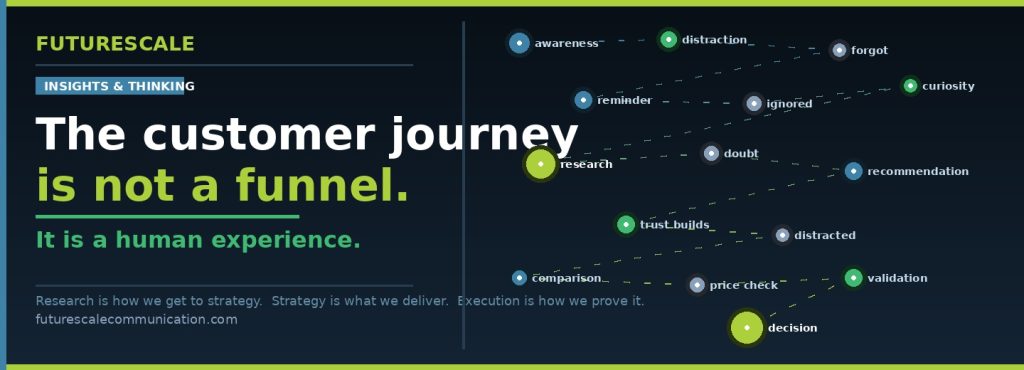
People become aware of something and forget about it. They get a recommendation and ignore it. They bookmark something and never return. They are almost ready to act and then something in their life interrupts them. They come back weeks later and decide in under two minutes.
The journey loops, reverses, pauses for months and then accelerates without warning. It responds to things that have nothing to do with the brand – a change in personal circumstances, conversation that reframes a priority, or a moment of readiness that arrives on its own schedule.
A strategy built on the assumption of linearity will always underperform because it is solving for a customer who does not exist. The customer who exists is moving through a far more complex and far more human process.
Emotion decides before logic arrives
Most decisions are made emotionally before logic enters the picture. People feel their way to a conclusion and then use information to justify it afterwards. This is not irrationality but, simply how human cognition works where the emotional system is faster than the rational one and it gets there first.
By the time a person is actively searching for reasons to buy something, they have often already decided. What they are doing is not evaluating. They are seeking permission to act on a conclusion they have already reached. They are not looking to be persuaded. They are looking to be reassured.
Persuasion and reassurance require completely different communication responses. Knowing which one your customer needs is the work that research makes possible.
Trust travels through other people first
Before committing to almost anything significant, people look for confirmation from someone they trust, not from the brand but another person.
A review, recommendation and or community group. Someone who has already done what they are considering doing and can report back on what happened. Trust is not built by a brand and transferred directly to a customer – it travels through other people first and arrives carrying their endorsement.
This is why word of mouth consistently outperforms advertising across every category and every market. It is not nostalgia for a simpler era of marketing but a structural reality of how human beings reduce risk before making consequential decisions. The brand that understands this designs for the social layer of the journey, not just the direct one.
Timing is readiness, not scheduling
The right message at the wrong moment is the wrong message. A person who is not ready will not respond regardless of how compelling the communication is. A person who is ready will act on very little because the decision infrastructure is already built.
Consider the South African household where the person responsible for purchasing decisions has been awake since before dawn managing the logistics of a family’s day. By the time they encounter a brand message they have already made dozens of decisions and are carrying a cognitive and emotional load that most communication strategies never account for.
Timing in the customer journey is not about the optimal hour to send a push notification. It is about understanding where in their life a person is when they encounter you and whether that moment is one they have the capacity and the inclination to act in.
What understanding the journey actually changes
When strategy is built on the actual customer journey rather than the assumed one, several things change.
The questions you ask before writing a brief change. Instead of ‘what do we want to say’ the question becomes ‘where is the customer in their journey and what do they actually need from us at this moment.’ The metrics you track change. Instead of measuring impressions and click-through rates in isolation, you begin to map signals of readiness, trust and intent. The channels you prioritise change. Instead of broadcasting to the widest possible audience, you focus on showing up with precision at the moments that matter.
Most significantly, the relationship between the brand and the customer changes. A brand that understands how people actually move towards decisions stops trying to push customers through a process and starts showing up as genuinely useful at the points in their journey where useful things are welcome.
That shift from process thinking to behaviour thinking is where strategy stops being a plan and starts being something a real person can actually use.
The work worth doing
Understanding the customer journey properly is not a creative exercise. It is a research discipline that requires interrogating assumptions, analysing real behaviour, mapping decision patterns across real contexts and building strategy around what the evidence shows rather than what the brief assumes.
The customer journey is messy, non-linear and deeply human. The brands that navigate it most effectively are the ones that accept that reality rather than trying to simplify it away.
Understand the human experience behind the decision and everything else follows.
Futurescale is a research-first marketing, strategy and data-led growth agency based in Pretoria, South Africa. We help B2B organisations understand how their customers actually make decisions and build strategy around what the evidence shows.
Research is how we get to strategy. Strategy is what we deliver. Execution is how we prove it.
futurescalecommunication.com